During the quite evening of June 15, 2021, life in Melamchi changed forever. The serene river that once nourished the Melamchi region turned furious as a glacial lake in the Helambu region burst without warning, triggering Glacial Lake Outburst Flood (GLOF) that led to subsequent glacier melting, landslides, and floods resulting in cascading impacts. The raging flood tore through settlements, fields, roads, and memories. In moments, life and livelihoods were swept away. Families who had lived for generations by the river were left counting the cost not only in money, but in peace, health, and dignity.
Each household bore an average economic loss of over US$52,113. Yet, the support they received averaged just US$380, indicating a significant gap in monetary support. Beyond economic hardship, mental health struggles affected 85% of the people. Further investigation by Prakriti Resources Centre (PRC) shows that economic insecurity is a major cause of mental health problems among families. During the investigation, one of the elders said, “The house I worked so hard to build still had an unpaid loan against it when the flood destroyed it. Now I am in debt for this new house too. With all these financial obligations, I don’t truly feel like I own this place.” Majority of those in the research area mentioned that they would embrace any resilience support opportunities offered by institutions.
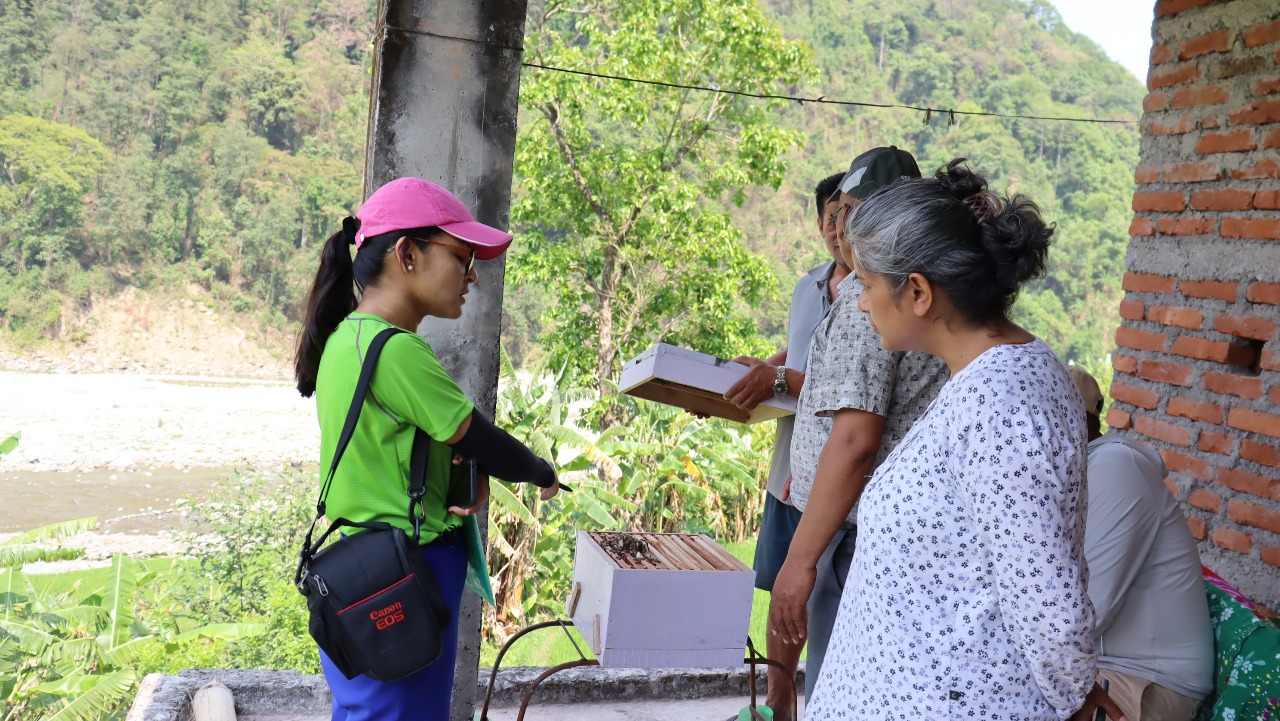
The case of Melamchi river flood showed a critical gap in how loss and damage, especially non-economic loss and damage such as psychosocial impacts, are understood and addressed. While deeply felt, they remain less explored and overlooked in policy responses. Recognizing this gap, PRC brought a seed of hope in the form of a livelihood support program centered on something small, yet powerful: bees. It distributed bee hives to 45 needy households in Melamchi Municipality, not just to restore income but to support dignity and resilience. The beekeeping initiative is a part of a broader effort to integrate understanding of psychosocial impact in climate recovery and response strategies.
A Buzzing New Beginning
On May 13, 2025, the PRC team visited Melamchi Municipality to monitor their bee-keeping support initiative. Among those the team met was Asmita Deuja, a 36-year-old female from Ward No. 6. Her family lost their agriculture land and a home to the flood, “We lost 6 melos (4.8 × 10⁻⁵ hectare) of land,” she said quietly, eyes reflecting the strain of loss and the hope of renewal. “This is the first time any organization helped us rebuild our livelihoods.” For Asmita, the bee hives meant more than honey that symbolized a second chance. Her curiosity and determination were unmistakable. “I watch YouTube videos to learn more about bee keeping. My kids love to have honey with chapatis, and if this works out well, it could be a great source of income.”
Krishna Bahadur Thapa, 45, also embraced the opportunity with hope. “Losing 3 – 4 ropani (0.15 – 0.20 hectares) of land valued at up to NRs. 80 lakh (US$ 58,181.50), with each ropani previously worth NRs. 15 – 20 lakh (US$ 10,909.03 to 14,545.37) was a crushing blow for Mr. Thapa. But for the first time, thanks to Prakriti’s intervention, he saw a viable path forward. “If this works,” he said with conviction, “I will expand it on my own. It’s a good intervention for our landscape and a good way to earn.”
Stitching Together What Was Torn
For PRC, this program is not just about economic support. It’s about healing, reconnecting people with nature, with each other, and with the possibility of a better future. Through these buzzing hives, the people of Melamchi are beginning to rediscover their strength and agency. They are no longer just survivors of the climate-induced massive destructive flood. They are beekeepers, entrepreneurs, and stewards of sustainability. The bees of Melamchi may be small, but in their quiet labor, they are helping rebuild lives, restore confidence, and pollinate hope across a land that has seen too much loss. And through the hum of every hive, one can almost hear a message whispered in the breeze: “Resilience lives here.”